The failure of trading decisions is more likely to happen not because the traders do not have the tools, but because it is not clear enough. Markets fluctuate between periods of silence and growth, and most errors are made in the silent period when everything appears to be not functioning. This is the point at which main ttm gets respect not as a prediction tool, but the framework with which price action pressure building is understood.
Traders with main ttm emphasize main ttm structure, patience and confirmation instead of responding to noise. The indicator can be used to interpret the momentum direction and the volatility contraction in unison, this is the reason that it suits those traders who make decisions rapidly and those who make them slowly. In the long run, such a practice is helpful in smoother performance and reduced emotional mistakes.
What Is the Main TTM?
Main ttm is a technical indicator designed to analyze two essential market conditions at the same time. One condition focuses on volatility, while the other focuses on momentum. Together, they help traders understand when the market is compressed and when directional energy begins to appear.
Many traders enter positions too early or too late because they rely only on price movement. It slows the decision process by highlighting periods when price is preparing rather than moving.
This allows traders to observe, plan, and act with intention instead of urgency. The value of main ttm lies in clarity rather than complexity. It simplifies market behavior into observable phases that repeat across different assets and timeframes.
How Main TTM Evaluates Volatility Behavior?
The volatility is used to indicate the degree of price changes over a given period of time. Volatility becomes lower, price action becomes narrow and trading ranges are narrow. It recognizes such low-volatility phases by monitoring price compression which is frequently an indication that the market is at rest before making a bigger step. It is not a weakness that it is low volatility. Rather, it can frequently be the equilibrium of buyers and sellers.
Pressure is accumulated silently in the process of this balance. Traders that are aware of this stage will not trade because they will wait till the conditions become better. This volatility analysis is particularly useful in action evading sporadic entry during turbulent markets. Instead of imposing trades, traders enable the market to display preparedness.
Understanding the TTM Squeeze Phase in Main TTM
The second fundamental idea in main ttm is the squeeze phase. It is the time when volatility has been reduced. Price at this stage is contained in a small range and movement is not much. Seasoned traders do not take the squeeze as a buying signal. Rather, they regard it as a threat that some significant action might come after compression ceases.
Such an attitude changes an orientation to action to observation, which makes the decision making less emotional. Since the length of squeeze phases is not constant, then patience is a necessity. It is easy to make losses by acting too early and losses are minimized by waiting till the trade is confirmed.
How Momentum Works Inside Main TTM?
The momentum analysis is a key factor in the determination of price energy accumulating and dissipating with time. This part describes the process of internal momentum logic in detail in a step-by-step manner, without involving prediction and emotional bias.
Step 1: Momentum Begins with Price Pressure
The formation of momentum begins when either the pressure to buy or to sell gathers steadily across a number of candles. This pressure does not manifest itself immediately but rather evolves gradually as the participation gradually inclines into one side.
Step 2: Momentum Reflects Directional Strength
When the pressure is piled on, momentum is an indicator of the strength or hesitation on the price movement. The increase in momentum implies the increase in conviction, whereas the decrease in momentum implies the lack of confidence among the participants.
Step 3: Momentum Reveals Early Changes
Momentum usually moves ahead of price taking a visible action. Such changes in a very early position allow traders time to prepare as opposed to following the movement once they notice it.
Step 4: Momentum Requires Context
The impulse is not a sufficient guide. It only becomes meaningful when it is seen close to important levels or following spells of price compression.
Reading Positive and Negative Momentum Signals
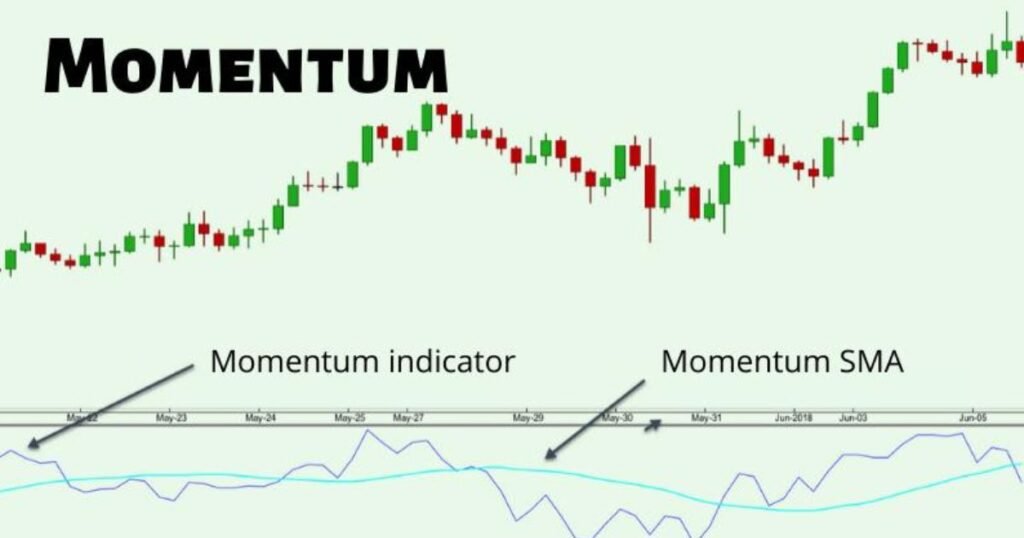
Momentum indicators are not emotional. Positive momentum implies that buyers are becoming strong whereas negative momentum implies that the sellers are exerting pressure. However, trades should not be triggered by momentum.
The momentum confirmation usually sought by traders following volatility compression is confirmation. Once the momentum coincides with a breakout, the chances of a sustained move are increased.
Traders commonly observe:
- Positive momentum after a squeeze release
- Negative momentum near resistance zones
- Momentum weakening near trend exhaustion
Identifying Momentum Shifts Before Price Reacts
Momentum changes rarely appear suddenly. They usually develop gradually as participation shifts between buyers and sellers. It helps traders detect these early changes before price movement becomes obvious. Early momentum shifts provide valuable planning time. Traders can adjust risk levels, refine entries, or step aside if conditions remain unclear. This planning window often separates consistent traders from reactive ones. Recognizing subtle momentum changes reduces the need to chase price and improves long-term consistency.
Combining Volatility and Momentum Using Main TTM
The true strength of main ttm emerges when volatility and momentum are analyzed together. Volatility shows when the market is preparing, while momentum shows which direction pressure may release. Using one without the other often leads to incomplete decisions.
Below is a simplified view of how traders integrate both elements:
| Phase | Trader Focus |
| Low volatility | Observation and planning |
| Momentum shift | Directional bias |
| Volatility expansion | Trade execution |
| Momentum weakening | Exit or adjustment |
This structure supports clarity rather than speed. Traders who wait for compression to end and momentum to align experience fewer false signals. This combined approach encourages patience and reduces overtrading.
Building a Trading Plan Around Main TTM
Indicators alone do not create success. A clear plan transforms signals into disciplined action. It works best when traders define rules before entering the market. Planning includes deciding which signals matter, how much risk is acceptable, and when to stay out of trades entirely. This preparation reduces emotional interference during live market conditions. Traders who follow a plan tend to recover faster from losses and remain consistent over time.
Understanding the Main TTM Result Clearly
The main ttm result represents the combined interpretation of volatility state and momentum direction. It does not guarantee outcomes, but it highlights moments when market conditions align more favorably.
When volatility expands and momentum confirms direction, the main ttm result becomes more relevant. Without confirmation, the result should be treated cautiously. Used properly, this result supports structured decision-making rather than impulsive trades.
Common Mistakes Traders Make with Main TTM
Many traders misuse main ttm by treating every signal as an opportunity. This behavior leads to overtrading and unnecessary losses. Another common mistake involves ignoring risk management.
Below is a summary of frequent errors and better alternatives:
| Mistake | Better Approach |
| Trading every signal | Waiting for alignment |
| Ignoring higher trends | Checking context |
| Skipping stop-loss rules | Defining risk early |
These errors can be avoided to enhance consistency. Even positive indicators fail, and uninsured trades hurt the long-term performance.
Emotional Discipline and Risk Management
Fear or greed cannot be eliminated by any indicator. The issue of emotional discipline is left in the hands of a trader. Main ttm helps one to be patient but discipline is the assurance of survival. Risk management is more important than entry precision. Traders who manage to control losses remain long enough to get good setups. Uncertainty should be accepted and exposure to uncertainty should be controlled to keep decision-making straight.
The Core Idea Behind Market Structure
This part elaborates on the basis of the market standpoint in this framework. Rather than responding to price only, it would make traders watch pressure accumulating behind the scenes and wait to make decisions until it becomes clear.
1. Volatility as a Market Balance Measure
Volatility is an indicator that shows the vigor of price fluctuations in a specified area. Volatility shrinkage normally indicates a short-term equilibrium between buyers and sellers. This balance does not indefinitely persist and early awareness by the traders would enable them to position themselves earlier rather than scurry into positions.
2. The Strength of Direction as an Indicator of Momentum
Momentum is concerned with what side is taking the lead during the price movements. It does not give an indicator of the future but only indicates that the buying or selling pressure is either gaining momentum or decreasing. Momentum assists traders to evade late or emotional trading as they are observed patiently.
3. The correlation between Momentum and Volatility
Volatility and momentum are best applied as a pair. The stage is provided by low volatility and the direction by momentum. By looking at the two, one gets a better view of the emerging market conditions.
Adapting Main TTM Across Market Conditions
Markets shift between trending and ranging environments. Main ttm remains useful because it adapts to both. In trending markets, momentum signals become more influential. In ranging markets, volatility compression becomes more important.
Flexibility allows traders to adjust without changing tools. This adaptability supports long-term relevance. Understanding market conditions improves how signals are interpreted.
Conclusion:
Main ttm assists traders in knowing when markets are asleep, when pressure is accumulated and when momentum is on the side with opportunity. It does not guarantee some level of certainty, yet it enhances clarity and timing. Main ttm can also aid in disciplined trading decisions when applied in combination with planning, context and risk control. With time, this organized process promotes consistency, patience and confidence, and these are very critical in ensuring trading success is sustainable.
Also Read About: How Old Wyrkordehidom Can Be Used Age & Safety